Enterprise SEO
3 Reasons Why Enterprise Ecommerce SEO Breaks Before Execution
Why enterprise ecommerce SEO breaks before execution — and how prioritisation, measurement and ownership decide whether it ever moves revenue.

Enterprise SEO rarely fails because the team lacks ideas. It fails because the organisation mistakes activity for progress.
The roadmap gets fuller. The reporting gets cleaner. More teams get involved. More work gets labelled "strategic". From the outside, it looks like momentum. Inside the business, the important things often move very little.
The problem is usually not effort. It is prioritisation, measurement, and handoff.
The 3 failure points: prioritisation, measurement, handoff
1. Prioritisation breaks before strategy does
I saw this clearly during my time as an in-house SEO Manager for a large commerce company in Sweden. Several of our most important categories were down 20–40% in organic revenue. These were not vanity sections; they were the engine of the business.
Usually, the fix isn't a lack of audits. It is a lack of sequence.
Most enterprise strategies are built to survive internal review, not to move revenue. They aim to support every market and align every stakeholder. But a broad strategy is often just a socially acceptable way of avoiding hard prioritisation. As more gets added, the language gets softer. Everyone sees their agenda in the plan, but nobody can see what needs to happen first.
The verdict: It isn't weak thinking that kills the start. It is weak sequencing.
2. Measurement creates false comfort
Reporting often tracks motion more easily than value. I see this repeatedly as a consultant: the dashboard looks healthy long after the underlying growth model has weakened.
If brand-led demand is carrying the total while non-branded growth stalls, the top-line view remains stable enough that leadership avoids making hard decisions.
Output gets celebrated while the pages closest to revenue stand still.
Reporting starts to create comfort where the business actually needs friction. Most enterprise teams don't have a visibility problem; they have a measurement problem. They track signals that are easy to present, not signals strong enough to force a change in direction.
3. Handoffs kill execution (and the budget)
When revenue stalls, the issue gets labelled an "SEO problem".
In reality, the problem is structural: product data is too weak, or ownership breaks the moment work moves across functions.
The strategy is no longer being tested by the market; it is being tested by the org chart.
The breakdown usually looks like this:
- SEO sees the organic opportunity
- Content has a separate editorial calendar
- Dev has a backlog of features that "convert better" than infra fixes
- Brand blocks "SEO-heavy" copy to maintain aesthetic control
- Paid/Performance bids on the same keywords, creating a "why bother?" sentiment toward organic work
The CMO's dilemma: speed vs. substance
From the CMO's perspective, the problem is often attribution and predictability.
They are under pressure to deliver quarterly targets. Paid media offers a clear "money in, money out" lever. SEO, by contrast, looks like a "black box" that requires cross-departmental sacrifice for a reward that might not show up until next year.
When "everyone" owns the outcome, no one owns the execution.
If the CMO doesn't see SEO as a core product requirement, it remains a "favour" that SEO asks of other departments. At this point, the strategy is being tested by internal politics and budget cycles.
If a strategy cannot survive the way the organisation actually works, it isn't a strong strategy — it's a decorative one.
Figure 1: Efficiency gains through product-level discipline
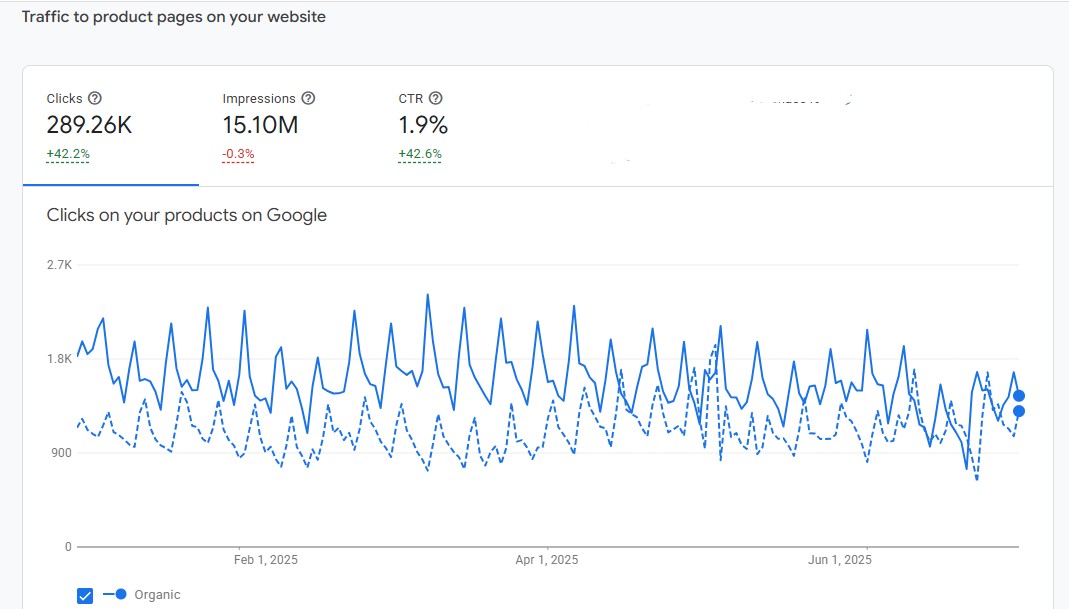
By improving the commercial integrity and technical attributes of product data, we achieved a 42.2% increase in product clicks (free listings) while impressions remained flat (-0.3%).
Optimising existing demand through better cross-functional execution changes the trajectory long before a global strategy is fully rolled out.
Read full case:
CASE #2 - Winning back the margin Google was charging forEnterprise teams often choose the "safest" work first
Most enterprise SEO teams aren't prioritising incorrectly. They are prioritising politically survivable work.
The business starts where internal risk is lowest: blog content and top-of-funnel assets. This work is easy to approve, but it is rarely where the commercial upside sits.
The real growth is closer to the bottom of the funnel: product pages and commercial templates.
But that work is harder.
It requires coordination across Dev, Product/Merchandising, and Brand. It forces accountability. So the "safe" strategy looks busy while the commercially vital pages stay underpowered.
Better strategy looks smaller
The strongest enterprise strategies I've seen usually look smaller than expected. They have less coverage, more sequence, and more commercial honesty.
They focus on one bottleneck at a time and follow four steps:
- Isolate the pages closest to commercial impact
- Decide what must move first (sequence)
- Assign one owner to carry work across teams (SEO product ownership)
- Measure whether the business outcome actually changed
This is not "less" strategic. It is just less performative.
Final thought
The companies that win are not the ones doing the "most".
They are the ones willing to make a harder priority earlier, attach real ownership to it, and keep going until the work survives contact with the organisation.
Everything else is just activity disguised as progress.
Read also:
- Why most e-commerce brands aren't equipped for agentic commerce
- Branded searches is warning signal most SEO teams ignore
- Why AI Visibility Is Not Yet A Reason To Rebuild Your SEO Budget