AI Search
How Google and AI Choose What to Show — Selection vs Ranking
Why traditional ranking position is no longer enough. Explore query fan-out, passage selection criteria, and how AI systems pick ecommerce sources.
(Hero illustration is AI-generated and used for illustrative purposes only.)
Ranking gets you into the pool. Selection decides whether you are actually used.
Most teams still measure search performance by position. Fair enough, that is what we were all taught to obsess over. But ranking is only the first filter. Once content enters the candidate pool, a second decision takes place: which parts of which pages actually get used to build the answer.
That second decision is now where visibility is won or lost. Which is mildly inconvenient for anyone still writing content as if the page itself is the only thing that matters.
Selection is not ranking
Google’s AI Overviews and AI Mode do not read pages the way a human does. They retrieve content at passage level. In plain English, they are looking for the section that answers the question, not just the page that happens to be about the topic.
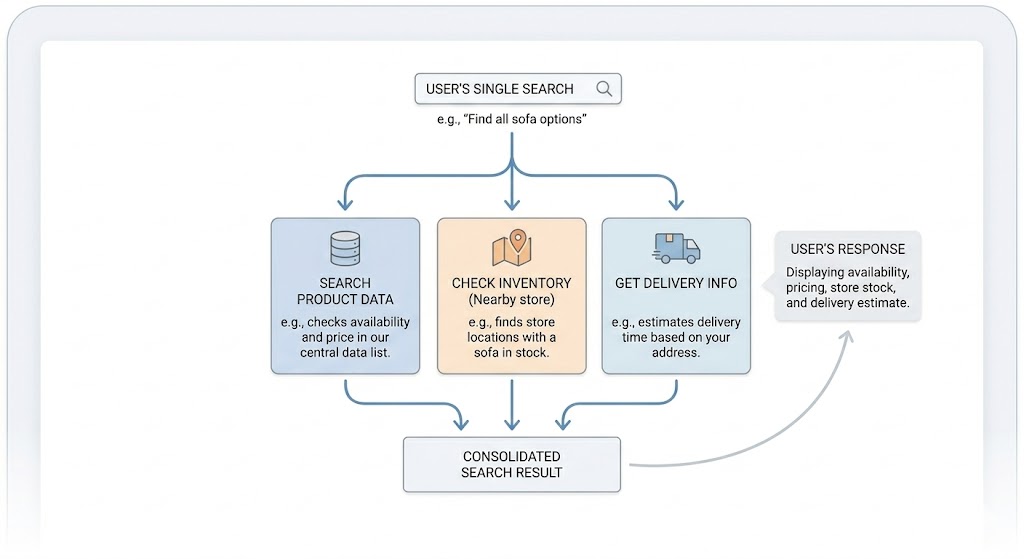
That retrieval process often involves query fan-out. One user question gets broken into several smaller questions. Each sub-question pulls its own results. The final answer is assembled from multiple sources, weighted against each other, and presented as one response.
A product page that answers the main question but ignores the surrounding ones will contribute less to that answer than a page that covers more of the buying journey. So yes, content depth matters. Not because it sounds strategic, but because the machine now has more places to choose from.
Boring truth: the better your content answers the actual question, the more likely it is to show up.
Why ranking alone is no longer enough
Ranking and selection are related, but they are not the same thing.
Traditional SEO still provides the foundation. Google’s AI Overviews and AI Mode draw from the same index as standard search results. Pages that are not indexed, not crawlable, or not topically relevant will not be considered. That has not changed.

What has changed is how much ranking position determines selection. According to Ahrefs' landmark tracking data updated on February 4, 2026, only about 38% of AI Overview citations now come from pages ranking in the organic top 10. Meanwhile, roughly 31% come from positions 11–100, with the median primary source landing at position 2.
The connection between holding a top organic spot and securing an AI citation is weakening at a staggering pace. Just seven months prior to their February update, the top-10 share of citations stood at a commanding 76%. The share has effectively halved in nearly half a year.
Ranking gets a page into the candidate pool, but it no longer guarantees selection as the final answer.
What the system is looking for
Observed citation patterns and retrieval research suggest several factors influence whether passages are selected and reused inside AI-generated answers.
Self-contained passages
Each section needs to answer a question without requiring the reader, or the system, to read the rest of the page first. Research on AI Overview citations suggests that shorter, direct passages tend to perform better than meandering ones. If the answer only appears after three paragraphs of warm-up, the machine is unlikely to wait patiently.
Specificity
AI systems do not reward vague “high-quality content” nearly as much as the SEO industry would like to believe.
In the peer-reviewed GEO (Generative Engine Optimization) study presented at KDD 2024, researchers from Princeton, Georgia Tech, IIT Delhi, and the Allen Institute for AI tested nine different ways to improve visibility inside AI-generated answers across 10,000 queries.
The study did not measure Google rankings directly, but rather how prominently content was reused inside generated AI responses.
One of the strongest performers was simple: replace generic claims with concrete statistics, comparisons, citations, and verifiable facts. Using their Position-Adjusted Word Count (PAWC) metric, the researchers found that evidence-heavy passages improved source visibility by roughly 30–40%, while generic optimization tactics and keyword-heavy writing often underperformed the baseline.
Turns out “high quality” is not a differentiator. Specificity is.
Content freshness
Roughly 44% of AI Overview citations come from content published within the most recent year. Pages that have not been updated lose ground to newer pages on the same topic, even if the original was more thorough at the time. The internet does not reward stillness forever. It just charges you later.
Format signals
Pages combining text, images, video, and structured schema markup are selected at significantly higher rates than text-only pages. Structured data, particularly product, FAQ, review, and pricing schema, helps AI systems interpret and extract content accurately. Missing fields in product feeds create gaps where useful content could otherwise have been used.
Authority signals
E-E-A-T, meaning Experience, Expertise, Authoritativeness, and Trustworthiness, remains a confirmed selection signal from Google. These signals appear to correlate with higher visibility in both search and AI-generated answers.
Google's fan-out effect
Query fan-out is the mechanism that makes content depth commercially important.
When a customer asks a complex or purchase-adjacent question, the AI system may resolve dozens of related sub-questions simultaneously. Those sub-questions pull from different sources: product pages, editorial content, reviews, structured data, and the Knowledge Graph.
The final answer is assembled from whatever combination of sources best covers the full question space. A product page that describes the product covers one part of that space. A page that also includes comparisons, use cases, common questions, and decision guidance covers more of it. Each additional sub-question a page can answer increases its contribution to the final response, and its visibility in the result.
This is not only an SEO consideration. It directly affects which products appear in AI-generated shopping answers, which brands enter the consideration set before a purchase decision is made, and how often a page is cited as the source.
What this means for ecommerce content
E-commerce teams that treat product content as a description of the product are covering only part of the buying journey.
A page that helps a customer decide by including clear product facts, specific comparisons, realistic use cases, and answers to common pre-purchase questions is also a page that AI systems have more reason to select. Those are the same requirements, addressed to two different audiences.
The content that performs well in this environment has a consistent profile. It is specific rather than general. It is structured rather than flowing. It is current rather than static. And it is detailed enough that both a customer and an AI system can extract a useful answer from it without needing to look elsewhere.
Generic product descriptions that mirror manufacturer copy offer no differentiation to a customer and no selection advantage to an AI system. Both audiences will find a more useful source. Which is fair enough, really.
Read more about my inhouse experiment when i was an SEO manager:
Not All Pages Are Candidates in Google AI and AI Search
The business case
When AI Overviews appear on a search results page, organic click-through rates drop by approximately 61% for pages that are not cited in the overview.
Pages that are cited in AI Overviews earn an average of 35% more organic clicks and 91% more paid clicks than competitors that are not cited.
The gap between appearing in the overview and appearing beneath it is not a visibility gap. It is a traffic and revenue gap. The content decisions that determine which side of that gap a brand lands on are being made now, in how product pages, category pages, and editorial content are structured and maintained.
What to build for
The practical implication is straightforward, even if the execution is not.
Each page needs to answer more than the primary question. Each section needs to stand alone as a usable answer. Each product description needs to contain specific, verifiable information rather than general claims. Schema markup needs to be complete, not partial. Content needs to be updated as the products, market, or information changes.
This is not a new content format. It is a higher standard for existing content. Pages that meet it perform better in organic search, in AI Overviews, and in AI-driven interfaces like ChatGPT and Perplexity that now influence purchasing decisions before a customer ever visits a website.
TL;DR
Google and AI systems do not compare pages. They compare passages, assembled across multiple sub-questions, weighted by specificity, freshness, authority, and format.
Ranking provides access to the candidate pool. Selection is determined by whether the content can be extracted and used.
For e-commerce, the work is consistent across all of it: accurate product data, complete structured markup, content that covers the buying journey rather than just the product, and a commitment to keeping that content current.
That is the standard the systems are applying. The brands that meet it will be the ones that get cited.
Ready to see real strategy?
Download the playbook where I detail how AI-driven traffic went from 0 to over £100,000 in revenue.
Google & AI Search for E-commerce — Here's Where to Start
Related reading:
- Why AI Visibility Is Not Yet A Reason To Rebuild Your SEO Budget
- AI Visibility And Why Your Dashboard Is Lying To You