Agentic Commerce
Agentic Commerce Is Already Here — And It's Already Exposing Structural Weakness
Why agentic commerce is already a commercial reality, what ACP and UCP actually mean, and the operating model brands need to win in machine-mediated discovery.
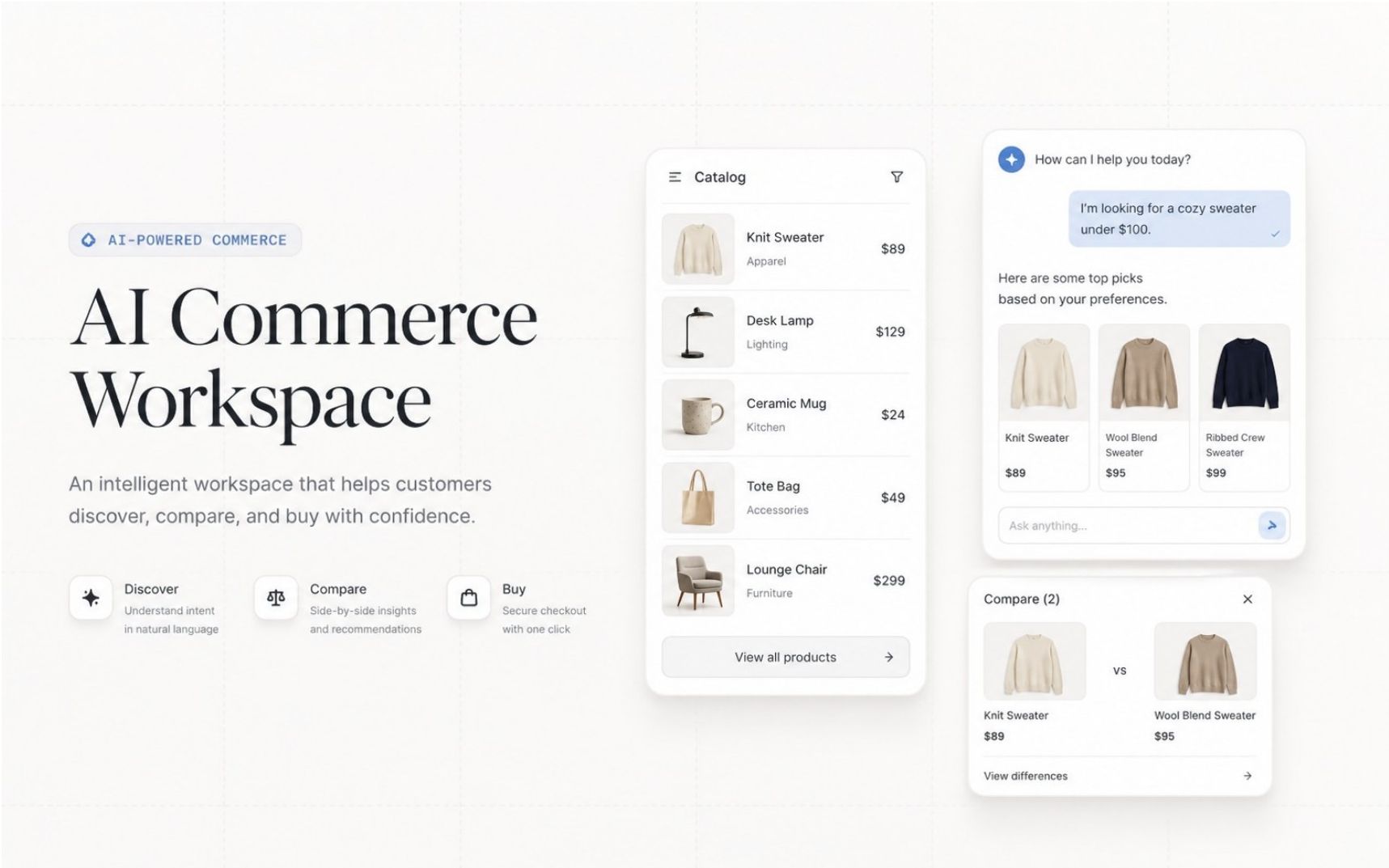
(Hero illustration is AI-generated and used for illustrative purposes only.)
The brands that win will not be the ones with the best story about the future. They will be the ones whose operating model can actually carry the work.
I have seen that pattern from the inside. Across three different ecommerce companies, the roadmap usually looked fine. The organisation underneath it did not. That is where initiatives go to die. Not in strategy. In execution, handoffs, and the small gaps nobody wanted to own.
That is why agentic commerce is interesting. Not because it sounds futuristic. Because it exposes whether a brand is actually ready to be represented by a machine. Most are not. A surprising amount of ecommerce is still held together by supplier copy, half-useful feeds, and optimism.
This is not a future state
Let me be direct: the shift is already happening.
According to the Adobe Digital Economy Index, AI-driven referrals grew sharply during the 2025 holiday season and kept that momentum into 2026. More important than the growth number is what happened after that: AI traffic started converting properly. The novelty wore off. The transaction logic did not.
That is the part people keep skipping. The story is not “AI traffic exists.” We knew that. The story is that machine-mediated discovery is becoming commercially relevant, which is usually when people start pretending they saw it coming.
The infrastructure behind that shift is being built through product feeds, merchant systems, structured data, and commerce integrations across the major platforms. None of that is glamorous. It is, however, the part that decides whether your brand can actually participate.
The question is not whether the interfaces will keep evolving. They will. The question is whether your business is ready to show up with something useful when they do.
What ecommerce looks like right now
In most ecommerce categories, product data is far too similar across competitors.
Same supplier copy. Same spec list. Same generic claims. Same sad little paragraph that says the product is “high quality” and leaves the customer to do the rest of the work.
When AI cannot clearly tell the difference between one product and another, price becomes the fallback. That is not a strategy. That is a clearance sale with better branding.
Most mid-sized brands cannot win that game for long. They do not have the margin, scale, or buying power to live in a permanent race to the bottom.
The real issue is that many brands still treat product content as admin. It gets copied in from the supplier, lightly adjusted if someone has time, and then published like that should somehow be enough. AI does not create that weakness. It removes the fog around it.
The friction of integration
This is where the language in the market is already getting messy.
Some systems are conversational and API-led. They depend on structured actions, clean attribute mapping, and data that can be understood without a human interpreter sitting in the middle doing a little guesswork for everyone.
Others are feed-led and search-led. They care about product completeness, entity trust, shipping reliability, and whether the merchant can actually fulfil what the platform is about to recommend.
Both matter. Neither is optional. If you want coverage where buying decisions are being formed, you need to be usable in more than one format.
That is the boring truth. Boring is often where the money is.
What happened with native checkout
A lot of the hype around native checkout has already been replaced by something more practical: deep linking, cart handoff, and other forms of machine-assisted purchase flow.
That tells you something useful. Platforms want to control discovery and shape the decision. Merchants want the sale. Everyone is pretending that handoff friction is a temporary detail. It is usually the whole problem.
The failure mode is familiar: the machine recommends a product, the backend says it is out of stock, and the whole thing collapses into a very modern-looking mess.
The lesson is not that the model failed. The lesson is that weak operational infrastructure gets exposed quickly when a machine starts doing the recommending.
If your stock data, tax logic, pricing, and fulfilment signals are not clean enough to survive that handoff, the platform is not the problem. You are.
The margin question
Convenience is never free.
If a platform owns discovery, it also owns more of the leverage around the journey. That affects upsell opportunities, basket structure, and the customer relationship after the first click. Retail margin is not only about cost of goods. It is about how much control you keep over the path to purchase.
The more compressed the journey becomes, the less room you have to influence lifetime value. That is a problem if your business still depends on repeat purchase, bundles, accessories, or any other part of the journey that does not fit neatly into a single recommendation card.
In other words: the platform gets efficiency. The merchant gets less room to be smart.
Customer ownership is the bigger risk
The bigger strategic risk is not traffic loss. It is relationship loss.
If the platform mediates more of the buying process, the merchant may still get the order but understand less about why it happened. That weakens CRM, lifecycle marketing, segmentation, attribution, product feedback loops, and repeat purchase strategy.
Traffic was never the real asset. Customer understanding is.
If the decision happens somewhere else, the merchant is left with the transaction and less of the context. That is a very expensive way to learn that your funnel got shorter and your insight got worse.
Related topic:
3 Reasons Why Enterprise Ecommerce SEO Breaks Before Execution
Searchable is not the same as recommendable
This is the distinction almost nobody is saying clearly enough.
A product can be indexed. It can rank. It can appear in Shopping. It can live in a feed. And still not be recommendable.
Recommendability requires more than presence. It requires the system to understand:
- What the product is.
- Who it is for.
- When it is the right choice.
- When it is the wrong choice.
- What differentiates it from alternatives.
- What proof supports the claim.
- Whether the merchant can fulfil the promise.
That is a product-data story. A merchandising story. A trust story. An operations story. It is also a story about whether the brand has bothered to give the machine a reason to prefer it.
The brands treating this as a pure search problem are solving the wrong problem.
Not every brand benefits equally
Agentic commerce will not reward every ecommerce business in the same way.
Commodity products and replenishment categories may benefit first. If the customer already knows roughly what they want, a faster path to purchase is useful.
Considered purchases are different. Premium products are different. Beauty is different. Furniture is different. Specialist equipment is different. High-consideration B2B is different.
In those categories, customers need confidence, education, proof, and a reason to believe they are making the right choice.
For those brands, AI may not just be helping someone buy. It may be helping them narrow the decision. That is still valuable, but it demands much better content and much better product data.
The infrastructure problem nobody wants to talk about
A lot of teams are talking about the interface while ignoring the infrastructure.
If your taxonomy is messy and your commercial copy is generic, you are invisible to an agent. If your attributes are incomplete, the machine has less to work with. If your fulfilment data is unreliable, the recommendation gets shaky very quickly.
The brands winning in 2026 are usually doing the unglamorous things properly:
- They maintain strong data fill rates on core product attributes.
- They write copy that explains why a product is the right choice for a specific use case.
- They keep inventory, shipping, and return data clean enough to trust.
- They answer real customer questions, not just keyword targets.
- They make sure the product page can stand on its own without the rest of the site doing rescue work.
That is not glamorous work. It is the work that compounds.
The uncomfortable part is that this has always mattered. Agentic commerce just makes it impossible to hide behind thin copy and a nice-looking homepage.
Where SEO still fits
This is not a story about SEO becoming irrelevant. It is a story about SEO becoming more accountable.
SEO used to be mainly a traffic-capture discipline. In an agentic commerce environment, it becomes about entity clarity, machine readability, product understanding, content specificity, commercial relevance, and trust signals.
That means the brands that invested in high-integrity SEO are better positioned than the ones that treated it as a ranking game and hoped the numbers would sort themselves out.
Good SEO was never just about rankings. It was about making the business easier to understand. For users. For search engines. For internal teams. And now, increasingly, for AI systems deciding whether your product deserves to be recommended.
That is why the shift matters. It is not exposing whether AI is real. It is exposing whether your SEO and content work ever had any commercial teeth.
What smart teams should do now
This is not the moment to rebuild the whole strategy around a future-state headline. It is the moment to remove structural weakness.
Ask the uncomfortable questions:
- Is our product data actually useful, or just tidy enough to pass a quick glance?
- Can a machine understand why our product is better for a specific use case?
- Do our commercial pages help customers decide, or do they just occupy the URL?
- Where are we most vulnerable to price-led comparison?
- Which categories are best suited to agent-led discovery?
- Which categories need more education, proof, and trust before a recommendation can land?
- What customer data would we lose if discovery moved off-site?
- What margin would we lose if upsell paths, bundle logic, or loyalty capture weakened?
The real shift is that agentic commerce removes the places where weak execution used to hide.
The brands that win will not be the ones with the best story about the future. They will be the ones whose operating model can actually keep up with the speed of the machine.
The real stress test
Agentic commerce may change how products are discovered, compared, and purchased. It does not remove the fundamentals of commerce.
Customers still need trust. Products still need differentiation. Merchants still need margin. Operations still need to work. Data still needs to be clean. Brands still need a reason to be chosen.
What changes is that poor execution becomes visible faster.
I have seen that pattern before. The roadmap looks strong. The organisation does not. And that is usually where the work stops.
The brands that win will be the ones whose product data, commercial clarity, and operating model can actually carry work across teams without it dying in the middle.
That is the real shift. And it is why agentic commerce is not just a search trend.
It is a commercial one.
Read also:
- Why AI Visibility Is Not Yet A Reason To Rebuild Your SEO Budget
- Why Branded Search Is The Early Warning Signal SEO Teams Ignore