Measurement & Strategy
AI Visibility And Why Your Dashboard Is Lying To You
AI visibility is a bundle of proxy signals, not a scoreboard. A practical framework for measuring retrieval, branded search, dark traffic, conversion and prompt sampling without fooling yourself.

AI visibility is easy to talk about and hard to measure well. Most teams are currently engaged in dashboard theatre, treating proxy signals like they are ground truth.
They are not. The reality is that AI search adds a layer between discovery and the click.
This layer changes what can be seen, what can be selected, and what can be trusted. It is not a scoreboard; it is a bundle of sub-decisions happening in a black box. If you are waiting for a single clean number to tell you what to do, you have already lost the plot.
Why measurement in AI search is messy
Traditional SEO was stable enough to build around: rankings, clicks, and impressions. AI search is different. A prompt can return different outputs depending on phrasing, context, and source availability. A citation can appear one day and disappear the next.
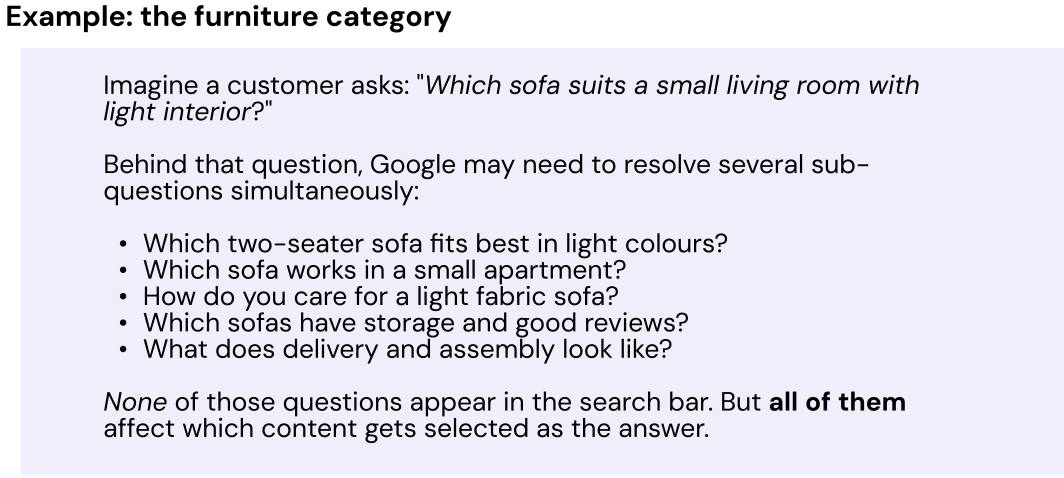
Example: The answer layer
A single customer prompt often hides half a dozen smaller questions. If you are not answering the questions the user did not ask, you are not an answer. You are just noise.
What you can actually measure
The mistake is not that AI visibility is opaque. It is that teams assume they are helpless. You just need to look at the right signals and stop pretending they tell the whole story.
Server logs
Server logs are one of the most honest places to start.
If your commercially important pages are being retrieved by AI-related crawlers, that tells you something real. If they are not, that is also useful. It does not mean the page is bad. It means it is not yet part of the system's working set.
That distinction matters.
Branded search trend
Branded search is one of the best early-warning proxies you already have.
If more people start searching for your brand after exposure in AI-driven environments, that may indicate awareness movement. It is not proof of causality. But it is often a strong signal that something is happening upstream of direct traffic.
This is why branded search deserves more attention than it usually gets. It is often the first measurable sign that a system is learning who you are, even if attribution remains annoyingly vague.
Read also: "Why Branded Search Is The Early Warning Signal SEO Teams Ignore"
Direct and dark traffic
A rise in direct traffic or traffic without a clean source can sometimes indicate discovery outside traditional click paths.
That does not mean every direct visit is AI-related. It obviously is not. But when patterns move on commercial landing pages that are also being surfaced in AI contexts, it becomes worth investigating.
This is where judgment matters more than dashboard theatre.
Conversion on AI-crawled pages
If pages retrieved by AI systems also convert well, that is a meaningful signal.
It suggests the structure, specificity, and commercial clarity of the page are doing more than helping discovery. They are helping decision-making. That is worth paying attention to.
It does not prove AI caused the conversion. But it can tell you which pages are doing a better job of carrying intent through to action.
Prompt sampling
One of the more useful methods is simple prompt sampling (very popular among academics).
Pick a set of purchase-adjacent questions and test them regularly across AI assistants and AI search environments.
Track whether your brand:
- Appears
- How it appears
- And in what context
You are not looking for perfect statistical precision. You are looking for pattern recognition. That is enough to make better decisions than most dashboards ever will.
What these signals do not tell you
This is where a lot of teams get sloppy.
A citation does not tell you why you were selected.
A rise in branded search does not prove AI caused it.
Direct traffic does not automatically mean AI discovery.
A page being crawled does not mean it is winning commercially.
In other words: the signal is real, but the interpretation is conditional.
That is reality.
The mistake is not that proxy metrics exist. The mistake is pretending they are more definitive than they are. A number is not a decision, even if it looks very polished.
Why proxy data still matters
If exact measurement is impossible, should you ignore the signal?
No. That would be worse.
Proxy data is useful because it gives you direction. It tells you where to look, what to prioritise, and which pages deserve more attention. It is decision support, not final proof.
You do not need certainty before acting. You need enough evidence to make the next move better than the last one. That is how good teams operate. They do not wait for perfect clarity in a system that is not built to give it.
Why you are ignored
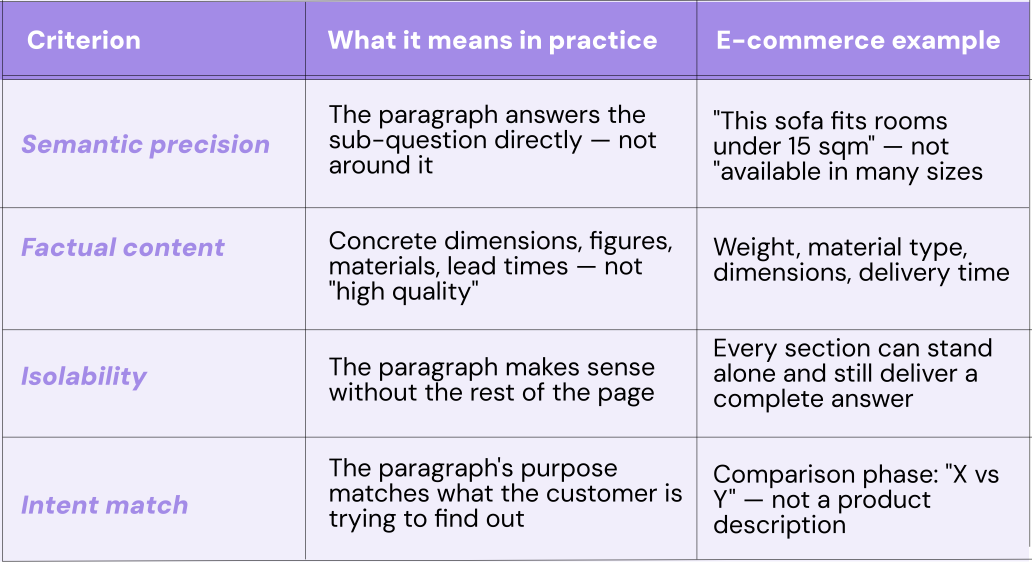
Visibility is a vanity metric if you are not being selected as the answer. The pages that win are the ones that are easiest for a machine to use.
What leadership actually needs to know
Your leadership does not need a dashboard with more moving parts. They need to know if AI visibility is changing commercial outcomes. This requires a sequence of logic.
That means asking:
- Are more of our pages being retrieved?
- Are branded searches rising?
- Are the right pages converting better?
- Are we reducing friction in the buying journey?
- Are we making the business easier to recommend?
Those are better questions than "How visible are we in AI?"
Not because visibility does not matter. It does. But because visibility only matters if it changes something the business can feel.
Related reading: "Why AI Visibility Is Not Yet A Reason To Rebuild Your SEO Budget"
The three questions that matter
When you strip away the noise, there are really three questions that matter.
1. Can it be retrieved?
If the page is not showing up in the systems that matter, it cannot influence the answer layer.
2. Can it be selected?
If the content is vague, generic, or structurally weak, it may be retrieved but still ignored.
3. Does it drive commercial value?
If the page is visible and selected but does nothing for the business, then visibility is just a vanity metric with better branding.
That is the real measurement framework.
Simple enough to use. Uncomfortable enough to be useful.
What good measurement looks like in practice
Good measurement in AI search is a mix of technical signals and commercial judgment.
It starts with the pages that already matter:
- category pages
- high-value product pages
- comparison pages
- pages that already receive traffic
Then it asks whether those pages are:
- retrieved
- understandable
- usable as an answer
- commercially effective
That is much more useful than trying to measure AI visibility as if it were a single clean metric.
It is not. It is a system of signals. And systems are what SEO people should be good at anyway.
What to do next
If you want to work with AI visibility properly, stop looking for a single answer and start building a signal stack.
That means:
- watching retrieval
- tracking branded search
- monitoring commercial page performance
- sampling prompts regularly
- using the data to improve priority, not performance slides
The point is not to measure everything. The point is to measure enough to make the next decision a better one.
If you want the more practical framework for where to start, the playbook goes deeper.
Ready to see real strategy?
Download the playbook where I detail how AI-driven traffic went from 0 to over £100,000 in revenue.
Google & AI Search for E-commerce — Here's Where to Start
FAQ
Can you measure AI visibility accurately?
Not exactly. You can measure useful signals, but not perfect causality.
Which AI visibility metrics matter most?
Server logs, branded search trend, direct traffic patterns, conversion on AI-crawled pages, and prompt sampling.
Is branded search a good proxy for AI discovery?
Yes, but only as one signal among several. By itself, it suggests movement. It does not prove the source.
Should AI visibility change budget allocation today?
Not on its own. It is too early to make major budget decisions on one incomplete signal.